<?xml version="1.0" encoding="utf-8"?><feed xmlns="http://www.w3.org/2005/Atom" ><generator uri="https://jekyllrb.com/" version="4.4.1">Jekyll</generator><link href="https://blogtest.mrguilt.com/feed.xml" rel="self" type="application/atom+xml" /><link href="https://blogtest.mrguilt.com/" rel="alternate" type="text/html" /><updated>2026-04-03T16:15:09-04:00</updated><id>https://blogtest.mrguilt.com/feed.xml</id><title type="html">Charles Barilleaux’s Blog Testbed</title><subtitle>This is the testbed for my blog. It will include making sure posts look right, as well as more significant changes.</subtitle><author><name>I. Charles Barilleaux</name></author><entry><title type="html">Impacts to Little Miami Trail During I-275 Construction</title><link href="https://blogtest.mrguilt.com/2026/03/24/lmt-impacts.html" rel="alternate" type="text/html" title="Impacts to Little Miami Trail During I-275 Construction" /><published>2026-03-24T13:00:00-04:00</published><updated>2026-03-24T13:00:00-04:00</updated><id>https://blogtest.mrguilt.com/2026/03/24/lmt-impacts</id><content type="html" xml:base="https://blogtest.mrguilt.com/2026/03/24/lmt-impacts.html"><![CDATA[<p><em>This note was sent to the address on the Ohio Department of Transportation contact listed on the sign (and I may send it to others).</em></p>

<p>Hi!</p>

<p>I saw the signs on the Little Miami Trail regarding the work on the car-only road, I-275, and its impacts on the multiuse trail beneath it. You invited comment about the proposed impacts. As an avid cyclist and frequent trail user, I feel it necessary to do so.</p>

<p>I have reviewed both the sign (photo attached) and the <a href="https://publicinput.com/i275smartlane?utm_source=publicinput&amp;utm_medium=qr_code#tab-75387">project web site</a>. While it does list an eventual, potential bridge for non-motorized traffic between the trail and Lake Isabella, it sounds more prospective than planned. The web site offers no clear description of impacts and mitigations to the trail during construction, so these comments are based solely on what’s on the sign. If there is additional information or a misunderstanding on my part, please provide clarification–it’s more than welcome.</p>

<p>The sign describes “intermittent closures of the trail during future construction” between Beech Road and Bridge Street. This effectively cuts off the approximately 15 miles of the trail from the northern sections. I think this will have huge impact to trial users who rely on the trail for a variety of reasons. Some specific practical concerns:</p>

<ul>
  <li>“Intermittent” is not clearly defined. Will it only be during weekday work hours (8-5), or 24x7? How frequently will this be closed? Having the trail open outside working hours would be less impactful that frequent 24x7 closures.</li>
  <li>The detour is is inadequate, and, frankly, insulting to trail users. I consider myself an experienced cyclist–I can share my bona fides if you wish–and will use the proposed detour. It includes multiple significant hills and blind corners on a fairly busy road. The should contains several broken sections, and drivers do not respect cyclists’ right to the full lane. I take extreme caution on this section. I can’t imagine less experienced cyclists trying to use the proposed detour. There is no sidewalk for pedestrian traffic. To put it bluntly, this is not a attempt to accommodate trail users. Instead, it feels like a cynical and insincere play to say you offered a detour in order to check a box and move the project forward.</li>
</ul>

<p>If are questions regarding my assessment of the detour, I’d be happy to ride it with anyone on the project who is interested, provided they do so while on a bicycle. We can discuss this proposal once we have completed the ride and they have experienced it first hand.</p>

<p>I also have a philosophical issue with this detour. While legally riding on the roads, I’ll hear the shout of “get on the trail” from motor vehicle operators. Now, for a project in support of a road exclusively for motor vehicles, that trail cyclists are told to use is being taken from us with, for all intents and purposes, no alternative or compensation. From an ethical point of view, this is wrong and unfair.</p>

<p>I feel it is imperative that this project be delayed until the needs of trail users can be better accommodated during the construction.</p>

<p>Thank you,</p>

<p><a href="/images/lmt-close-sign.jpg"><img src="/images/lmt-close-sign.jpg" height="400px" /></a></p>]]></content><author><name>I. Charles Barilleaux</name></author><category term="Cycling,Cincinnati,Opinion" /><summary type="html"><![CDATA[This note was sent to the address on the Ohio Department of Transportation contact listed on the sign (and I may send it to others).]]></summary></entry><entry><title type="html">Thoughts on the MacBook Neo</title><link href="https://blogtest.mrguilt.com/2026/03/05/MacBook-Neo-Thoughts.html" rel="alternate" type="text/html" title="Thoughts on the MacBook Neo" /><published>2026-03-05T12:00:00-05:00</published><updated>2026-03-05T12:00:00-05:00</updated><id>https://blogtest.mrguilt.com/2026/03/05/MacBook-Neo-Thoughts</id><content type="html" xml:base="https://blogtest.mrguilt.com/2026/03/05/MacBook-Neo-Thoughts.html"><![CDATA[<p>Conventional wisdom among a certain type of technology “enthusiast”/wannabe pundit is that Macs are “too expensive.” There is an “Apple Tax”–you are paying too much for the Apple name. I’ve always thought that was a incorrect (and, honestly, not said in good faith). Yes, Apple offered very little at lower price points in their current line. But, if you compare their current line to <em>comparable systems</em> of HP, Lenovo, or Dells–the same specifications, generation of processors, and build quality, this price differential started to disappear. Yes, to get a new, current Mac command a premium, but one that is on par with <em>similar</em> systems from other manufacturers. Other vendors seem less expensive, overall, because they offer cheaper, lower end–machines with less powerful processors, less RAM and storage, and a cheaper build quality. Or, they keep last year’s still very capable model around as a cheaper option (something that is true of Apple through third parties).</p>

<p>The “Apple Tax,” in this light, is a bit of an illusion.</p>

<h2 id="enter-the-macbook-neo">Enter the MacBook Neo</h2>

<p>This week, <a href="https://www.wired.com/story/new-budget-apple-macbook-2026/">Apple announced the MacBook Neo</a>, creating a low end offering. It uses an A-series chip, like those in an iPad or iPhone, instead of the more powerful M-series chip. It has a simpler keyboard, without backlight, and a screen that isn’t <em>quite</em> as good as those found on the Air and Pro models. It has less RAM, and one of the USB ports only supports USB 2, limiting speed and the ability to support a monitor on that port.</p>

<p>But it does this for a price point starting at $600. With an aluminum case, it’s build quality is on par with the rest of the MacBook line, and far exceeds most Windows laptops at that price point. Apple claims a sixteen hour battery life, and they tend to not exaggerate those claims too grossly. I haven’t seen one in person (few have), but it sounds like a very capable machine. Apple also made it fun, with cool colors that remind a lot of us of the <a href="https://everymac.com/systems/apple/ibook/specs/ibook.html">original translucent clamshell iBook</a>. They made choices to balance what their target audience <em>needs</em> in order to get a price point they <em>want</em>.</p>

<p><em>Since few have had the opportunity to touch a MacBook Neo (and I am not among them), much less put it through its paces, a lot of this post is based on initial reviews and some speculation. It may prove to be different once the machine is actually released.</em></p>

<p>While it sounds underpowered for a lot of things–hard core video editing, animation, or high end graphics–it sounds perfect for what a lot of folks need: web browsing, media consumption, and browser use. I think this will be great for:</p>

<ul>
  <li>A “First Laptop” for students, especially K-12</li>
  <li>People who want a personal laptop, but a nice one. This would be especially true for people who want their own system aside their Worktop.</li>
  <li>Businesses who want to extend their Apple fleet to more roles (where the M-spec is not required). I’ve already heard that in health care, this may prove to be a game changer.</li>
</ul>

<p>A lot of technology journalists see this as setting a standard for laptops at this price point. It reminds me of how the iPhone <em>defined</em> what a SmartPhone should be, after years of figuring out just what they should be.</p>

<h2 id="haters-gonna-hate">Haters Gonna Hate</h2>

<p>Apple has long been a target of the too-cool technology influencer set. There is, of course, the “Apple Tax,” but also claims the machines are underpowered (usually relative to a gaming rig), not upgradeable, or more of a “lifestyle brand.” Meanwhile, real people happily buy Macs because they “just work.” They have an ecosystem that works well with them, and are broadly supported. They tend to last longer and don’t get dropped from support as quickly as a Windows system. The fact is, Apple has never really targeted the technology influencer crowd, even if a lot of tech savvy people prefer them.</p>

<p>I’m among them. I regard myself as a hard core “Alpha Nerd.” I’ve used DOS, Windows, OS/2 OpenVMS, and a variety of flavors of UNIX. I have several Linux servers scattered around. But my personal system is Mac. As I’ve stated elsewhere, I appreciate having a UNIX system for under the hood, but one that can support common applications natively when I just want to get work done.</p>

<p>The MacBook Neo will be no exception to this hate. There are already complaints about soldered RAM, only one USB 3 port, or other choices made. <strong>THEY ARE MISSING THE POINT!!!</strong> This is not an all-out gaming rig. Professional video editors are not the target. The phrase that best describes this computer seems to be “fit to purpose.” It’s going to meed most of its users’ needs. I suspect they will love it.</p>

<h2 id="its-just-an-ipad-with-a-keyboard">“It’s Just an iPad with a Keyboard”</h2>

<p>One common complaint already being circulated is that this is running an tablet chip–that it is just an iPad in a different form factor. But I think there is a critical difference: this incorporates a number of desktop* features, and, more critically, a desktop operating system.</p>

<p>These days, Apple operating systems are all derivatives of OS X, itself a descendent of NeXTStep. While this means they all have UNIX roots, only MacOS can be said to behave like UNIX. There is a prompt you can open. You can run software on it that came from sources other than the App store, or even compile your own. A lot of packages support it, along with Linux and Windows.</p>

<p>Likewise, there are native, standard ports of a variety of applications, most notably, <a href="https://www.microsoft.com/en-us/microsoft-365/mac/microsoft-365-for-mac">Microsoft Office</a>. These are the full, standard desktop version everyone uses. In the case of office, it’s mostly the same as the version for Windows. It’s not a stripped down tablet-or-phone version. They work the same as what anyone else is running.</p>

<p>I think this broad native support for <em>real desktop applications</em> is a key differentiator. If a student is following along in class, the instructions will more closely map what they experience. If there is a special package required, odds are, they can run it. There may be some things it doesn’t have the horsepower to run (or run effectively), but it will be more relevant to users.</p>

<p>For most of the Apple Silicon era, if someone asked “do I need a MacBook Pro or Air,” the answer has been that, if you have to ask, you probably need an Air. It may not be long before a parallel answer evolves between the Neo or Air.</p>

<h2 id="network-effect">Network Effect</h2>

<p>I believe the Neo is going to be a driver that significantly expands the MacOS user base. It positions a high quality system at a much more affordable price point, and avoids the compromises that a tablet would have. As more people buy them and use them, more software will target MacOS in general, and the Neo in particular. It’s not hard to imagine Apple creating an upgraded version.</p>

<p>As a twenty-year Mac user, I support this completely.</p>

<h2 id="conclusion">Conclusion</h2>

<p>I’m writing this the day after it was announced. Most of the technology journalists I’ve read have done little more than touch one much the same way I might in an Apple store in a few months. How it will work in practice is unknown to everyone. Everything I’m saying may be proven wrong.</p>

<p>That said, I can easily see this becoming my default recommendation for friends and family who are looking for a new computer but don’t want to spend a grand. I can see recommending it for people who <em>would</em> spend that much. Most of the people who would ask such a general question will be more than happy with such a system. They aren’t doing tons of video editing, aren’t connecting a bunch of external monitors or storage, and just want to surf the web and run a spreadsheet. This is the perfect system for this.</p>

<p>While I see myself as a bit of an Alpha Nerd. But, if I’m honest with myself about most of my day-to-day use, it may be a fit for me. Much of my hard core geeking is accomplished by connecting to remote systems. However, from a practical point of view, my MacBook Air M3 that is going strong and I foresee many more years of using it. From a less-practical point of view, the Alpha Nerd in me wants to have a spec-heavy monster of a system, and this is a good compromise relative to the MacBook Pro. I’m not getting a Neo today, but, in a few years, it’s going to be a consideration.</p>

<p>I hope the MacBook Neo lives up to its promise. It can be a game changer by bringing more people into the Macintosh ecosystem, and redifine what a $600 laptop can be.</p>

<p>*In this context, I use the term “desktop” to mean a dedicated personal computer, as we’ve had since the Altair 8800 in the mid-Seventies, as opposed to a tablet or SmartPhone. Laptops and computers-that-sit-on-a-desk are, in this perspective, the same thing with different form factors.</p>]]></content><author><name>I. Charles Barilleaux</name></author><category term="computers,geeky,MacBook,opinion" /><summary type="html"><![CDATA[Conventional wisdom among a certain type of technology “enthusiast”/wannabe pundit is that Macs are “too expensive.” There is an “Apple Tax”–you are paying too much for the Apple name. I’ve always thought that was a incorrect (and, honestly, not said in good faith). Yes, Apple offered very little at lower price points in their current line. But, if you compare their current line to comparable systems of HP, Lenovo, or Dells–the same specifications, generation of processors, and build quality, this price differential started to disappear. Yes, to get a new, current Mac command a premium, but one that is on par with similar systems from other manufacturers. Other vendors seem less expensive, overall, because they offer cheaper, lower end–machines with less powerful processors, less RAM and storage, and a cheaper build quality. Or, they keep last year’s still very capable model around as a cheaper option (something that is true of Apple through third parties).]]></summary></entry><entry><title type="html">When You Embrace Analog…</title><link href="https://blogtest.mrguilt.com/2026/01/19/embrace-analog.html" rel="alternate" type="text/html" title="When You Embrace Analog…" /><published>2026-01-19T11:30:00-05:00</published><updated>2026-01-19T11:30:00-05:00</updated><id>https://blogtest.mrguilt.com/2026/01/19/embrace-analog</id><content type="html" xml:base="https://blogtest.mrguilt.com/2026/01/19/embrace-analog.html"><![CDATA[<img src="/images/infinite-space.jpg" width=100% alt="When you embrace analog, you start to become able to find the joy in the infinite space between one and zero"><br>
<a href="/images/infinite-space.jpg"><i>full image</i></a>]]></content><author><name>I. Charles Barilleaux</name></author><category term="analog,RealPaperPost" /><summary type="html"><![CDATA[full image]]></summary></entry><entry><title type="html">From Bitly to Yourls</title><link href="https://blogtest.mrguilt.com/2025/12/24/from-bitly-to-yourls.html" rel="alternate" type="text/html" title="From Bitly to Yourls" /><published>2025-12-24T09:00:00-05:00</published><updated>2025-12-24T09:00:00-05:00</updated><id>https://blogtest.mrguilt.com/2025/12/24/from-bitly-to-yourls</id><content type="html" xml:base="https://blogtest.mrguilt.com/2025/12/24/from-bitly-to-yourls.html"><![CDATA[<h1 id="from-bitly-to-yourls">From Bitly to Yourls</h1>

<p>Eleven years ago, I <a href="https://medium.com/life-hacks/connecting-your-paper-notebooks-with-the-digital-age-32b77f6bddbf">read a post</a> about a technique to reference online material in hand-written notebooks. The idea was to use a URL shortener to write the “backhalf” of the URL in the notebook, with a delimiter (as well as a few formatting ideas for clarity). “Backhalf” refers to the shortened part of the link; “fronthalf” refers to the shortener. If a shortned url is <code class="language-plaintext highlighter-rouge">https://shortener.com/12345</code>, then <code class="language-plaintext highlighter-rouge">shortener.com</code> is the fronthalf, and <code class="language-plaintext highlighter-rouge">12345</code> is the backhalf. If I click on the link, it will go to some other site.</p>

<p>The author suggested using <a href="https://bitly.com">Bitly</a>, as, at the time, you could create a custom fronthalf as part of their free service. I mapped it to <code class="language-plaintext highlighter-rouge">l.mrguilt.com</code>, and my notebooks have scattered references ever since. This scheme has worked out rather well.</p>

<p>I learned recently that Bitly paywalled a number of features, including the custom fronthalf. I’ve been grandfathered in, for a time, but, as these things go, I knew it was a matter of time before they would force a subscription.</p>

<p>But I’m a geek with servers in the Cloud. I could set up my own URL shortener, with my own custom front end.</p>

<h2 id="yourls">Yourls</h2>

<p>I looked at a few, and settled on <a href="https://yourls.org">Yourls</a>. It had the most straight-forwward setup, though a bit quirky. After about an hour of tinkering, downloading components, and setting up a database, I was good to go. I had decided to retain Bitly as long as they’d let me, so the new frontend would be <code class="language-plaintext highlighter-rouge">s.mrguilt.com</code>. I decided to designate references to it as <code class="language-plaintext highlighter-rouge">&lt;&lt;backend&gt;&gt;</code>, where the Bitly version was <code class="language-plaintext highlighter-rouge">&lt;backend&gt;</code>.</p>

<p>So far, so good.</p>

<h2 id="exporting-from-bitly">Exporting from Bitly</h2>

<p>As I said, I suspected they would eventually end my grace period, and with it my custom frontend. I could use <code class="language-plaintext highlighter-rouge">bit.ly/backend</code>, and it would still work, so long as the overall service had a free tier. Also, at the end of the day, I viewed all of this as <em>my data</em>. I wanted to be able to put a copy on a device I controlled. Did Bitly have an export feature?</p>

<p>It did. But the export feature was also paywalled at a $30/month tier. Was there another way?</p>

<p>I could get a list of all the links in one list on the web site. ⌘-a even highlighted it all, so I was able to ⌘-c it into a text file. The formatting was goofy, but I had my data!</p>

<div class="language-plaintext highlighter-rouge"><div class="highlight"><pre class="highlight"><code>26-Nov-25
No tags

Favicon for sallysbakingaddiction.com
Soft Dinner Rolls Recipe - Sally's Baking
l.mrguilt.com/44oZ0fO


https://sallysbakingaddiction.com/soft-dinner-rolls/#tasty-recipes-67831
0 engagements
</code></pre></div></div>

<p>I then wrote a perl script to parse that into a comma separate values (CSV) file.</p>

<div class="language-plaintext highlighter-rouge"><div class="highlight"><pre class="highlight"><code>#!/usr/pkg/bin/perl
open(INFILE,"/~/bitly-dump.txt");


$foundit=0;
foreach $i (&lt;INFILE&gt;) {
    chomp($i);
    if($i=~ /.*l\.mrguilt\.com\/(.*)/) {
        print $1,",";
        $foundit=1;
    }
    if($foundit==1) {
        if($i=~ /(http.*)/) {
            print $i,"\n";
            $foundit=0;
        }
    }
}


close(INFILE);
</code></pre></div></div>

<p>Turned my copy-and-paste line into:</p>
<div class="language-plaintext highlighter-rouge"><div class="highlight"><pre class="highlight"><code>44oZ0fO,https://sallysbakingaddiction.com/soft-dinner-rolls/
</code></pre></div></div>

<p>I had my data!</p>

<h2 id="import-into-yourls">Import into Yourls</h2>

<p>I could have stopped there. However, Yourls had an import module. I tested it: I could import both the target URL as well as the backend. This meant that <code class="language-plaintext highlighter-rouge">l.mrguilt.com/12345</code> and <code class="language-plaintext highlighter-rouge">s.mrguilt.com/12345</code> would go to the same place. All my legacy references would continue to work as they had been. 88% of the Bitly URLs successfully imported. As of this writing, I have not spent a lot of time examining what didn’t work–it could be dead target URLs, for instance. Regardless, I have the spreadsheet to refer to.</p>

<p>I’ve decided to sunset my Bitly account after a month or so of running in parallel. I’ll probably go back to the older marker (<code class="language-plaintext highlighter-rouge">&lt;backhalf&gt;</code>) when I do. I’m quite pleased that I was able to not only create a replacement, but migrate my historical data into it.</p>]]></content><author><name>I. Charles Barilleaux</name></author><category term="computers,software,digital/physical" /><category term="integration,writing,office" /><category term="supplies" /><summary type="html"><![CDATA[From Bitly to Yourls]]></summary></entry><entry><title type="html">Beignets</title><link href="https://blogtest.mrguilt.com/2025/12/21/beignets.html" rel="alternate" type="text/html" title="Beignets" /><published>2025-12-21T05:00:00-05:00</published><updated>2025-12-21T05:00:00-05:00</updated><id>https://blogtest.mrguilt.com/2025/12/21/beignets</id><content type="html" xml:base="https://blogtest.mrguilt.com/2025/12/21/beignets.html"><![CDATA[<meta http-equiv="Content-Type" content="text/html; charset=UTF-8" />
<p><h1>Beignets</h1></p>
<a href="/images/beignets.jpg"><img src="/images/beignets.jpg" alt="A Plate of Beignets" height="300px"></a>
<p>
    Every year, I make beignets, a Louisiana spin on donuts for Hannukah. This is a very reliable recipe, and comes out really well.
</p>
<h2 id="ingredients">Ingredients</h2>
<table>
<colgroup>
<col style="width: 30%" />
<col style="width: 70%" />
</colgroup>
<thead>
<tr class="even">
<td>2¼ tsp</td>
<td>yeast</td>
</tr>
</thead>
<tbody>
<tr class="odd">
<td>¾ cup</td>
<td>water</td>
</tr>
<tr class="even">
<td>¼ cup</td>
<td>sugar</td>
</tr>
<tr class="odd">
<td>½ tsp</td>
<td>salt</td>
</tr>
<tr class="even">
<td>1</td>
<td>egg, beaten</td>
</tr>
<tr class="odd">
<td>½ cup</td>
<td>evaporated mild</td>
</tr>
<tr class="even">
<td>3½-3¾ cups</td>
<td>all purpose flour</td>
</tr>
<tr class="odd">
<td>2 tbsp (25g)</td>
<td>shortening</td>
</tr>
<tr class="even">
<td></td>
<td>vegetable oil for frying</td>
</tr>
<tr class="odd">
<td></td>
<td>powdered sugar, in a shaker, for dusting</td>
</tr>
</tbody>
</table>
<h2 id="preparation">Preparation</h2>
<ol type="1">
<li><p>Combine the Yeast, Water, and Sugar in the work bowl of a stand
mixer fitted with a dough hook. Let this sit until frothy, about 5
minutes.</p></li>
<li><p>Add the Salt, Egg, and Evaporated Milk. Mix on low speed, then
add half of the flour until it starts to come together, then add the
shortening. When the shortening is incorporated start adding the
remaining flour, a little at a time until most of it is
incorporated.</p></li>
<li><p>Knead the dough adding just enough flour as necessary to make a
non-sticky, smooth dough.</p></li>
<li><p>Place the dough into a large oiled bowl, loosely cover and let
rise until double in bulk (it can be made the night before and let it
rise overnight in the refrigerator).</p></li>
<li><p>After the dough has doubled in bulk, punch it down and turn it
onto a floured surface and roll out into a rectangle that is about 1/2″
thick. With a very sharp knife working at a diagonal to the rectangle,
cut into 2″ wide strips. Now cut into diamond shapes by making diagonal
cuts in the opposite direction.</p></li>
<li><p>Place the Beignets on a floured baking sheet to let rise about 40
minutes in a warm place</p></li>
<li><p>While the Beignets are rising, heat 2-3 inches of vegetable oil
in a large saucepan to 350-360 degrees.</p></li>
<li><p>Place 2-3 Beignets into the hot oil at a time, being careful not
to smash or deflate them. When they are golden brown, flip them over
until golden brown on the other side (They go pretty quickly so start
checking them right after they go into the oil).</p></li>
<li><p>Remove to paper towel lined plates to drain.</p></li>
<li><p>Serve hot topped with plenty of powdered sugar (because the dough
doesn’t contain much sugar, you will want a lot!). Best served with Cafe
au Lait. Enjoy!</p></li>
</ol>
<h2 id="notes">Notes</h2>
<ul>
<li><p>If I leave them in the refrigerator overnight, I’ll give them a
couple hours to come up to room temperature. I’ll also divide the dough
in half, and cook the first batch on Saturday, leaving the balance in
the fridge. I’ll make the rest on Sunday.</p></li>
<li><p>Some beignets will puff up—you may need to hold the under the oil
with tongs or a spider strainer.</p></li>
<li><p>I’ll Original recipe listed “⅛ cup shortening.” I converted to
tablespoons, but typically use grams.</p></li>
</ul>
<p>From <a
href="http://neworleanscuisine.blogspot.com/2005/05/new-orleans-cuisine-beignet-recipe.html">NOLA Cuisine</a></p>]]></content><author><name>I. Charles Barilleaux</name></author><category term="food," /><category term="recipe," /><category term="baking" /><summary type="html"><![CDATA[Beignets Every year, I make beignets, a Louisiana spin on donuts for Hannukah. This is a very reliable recipe, and comes out really well. Ingredients 2¼ tsp yeast ¾ cup water ¼ cup sugar ½ tsp salt 1 egg, beaten ½ cup evaporated mild 3½-3¾ cups all purpose flour 2 tbsp (25g) shortening vegetable oil for frying powdered sugar, in a shaker, for dusting Preparation Combine the Yeast, Water, and Sugar in the work bowl of a stand mixer fitted with a dough hook. Let this sit until frothy, about 5 minutes. Add the Salt, Egg, and Evaporated Milk. Mix on low speed, then add half of the flour until it starts to come together, then add the shortening. When the shortening is incorporated start adding the remaining flour, a little at a time until most of it is incorporated. Knead the dough adding just enough flour as necessary to make a non-sticky, smooth dough. Place the dough into a large oiled bowl, loosely cover and let rise until double in bulk (it can be made the night before and let it rise overnight in the refrigerator). After the dough has doubled in bulk, punch it down and turn it onto a floured surface and roll out into a rectangle that is about 1/2″ thick. With a very sharp knife working at a diagonal to the rectangle, cut into 2″ wide strips. Now cut into diamond shapes by making diagonal cuts in the opposite direction. Place the Beignets on a floured baking sheet to let rise about 40 minutes in a warm place While the Beignets are rising, heat 2-3 inches of vegetable oil in a large saucepan to 350-360 degrees. Place 2-3 Beignets into the hot oil at a time, being careful not to smash or deflate them. When they are golden brown, flip them over until golden brown on the other side (They go pretty quickly so start checking them right after they go into the oil). Remove to paper towel lined plates to drain. Serve hot topped with plenty of powdered sugar (because the dough doesn’t contain much sugar, you will want a lot!). Best served with Cafe au Lait. Enjoy! Notes If I leave them in the refrigerator overnight, I’ll give them a couple hours to come up to room temperature. I’ll also divide the dough in half, and cook the first batch on Saturday, leaving the balance in the fridge. I’ll make the rest on Sunday. Some beignets will puff up—you may need to hold the under the oil with tongs or a spider strainer. I’ll Original recipe listed “⅛ cup shortening.” I converted to tablespoons, but typically use grams. From NOLA Cuisine]]></summary></entry><entry><title type="html">I Hate That I Love Blackwing Pencils</title><link href="https://blogtest.mrguilt.com/2025/10/17/Hate-That-I-Love-Blackwing-Pencils.html" rel="alternate" type="text/html" title="I Hate That I Love Blackwing Pencils" /><published>2025-10-17T12:00:00-04:00</published><updated>2025-10-17T12:00:00-04:00</updated><id>https://blogtest.mrguilt.com/2025/10/17/Hate-That-I-Love-Blackwing-Pencils</id><content type="html" xml:base="https://blogtest.mrguilt.com/2025/10/17/Hate-That-I-Love-Blackwing-Pencils.html"><![CDATA[<p>There are some products that’s easy to hate on for their popularity. For instance, whatever the current trendy metal water bottle of the moment (Hydroflask, Stanley, etc.) seems to be an easy target for such ire.</p>

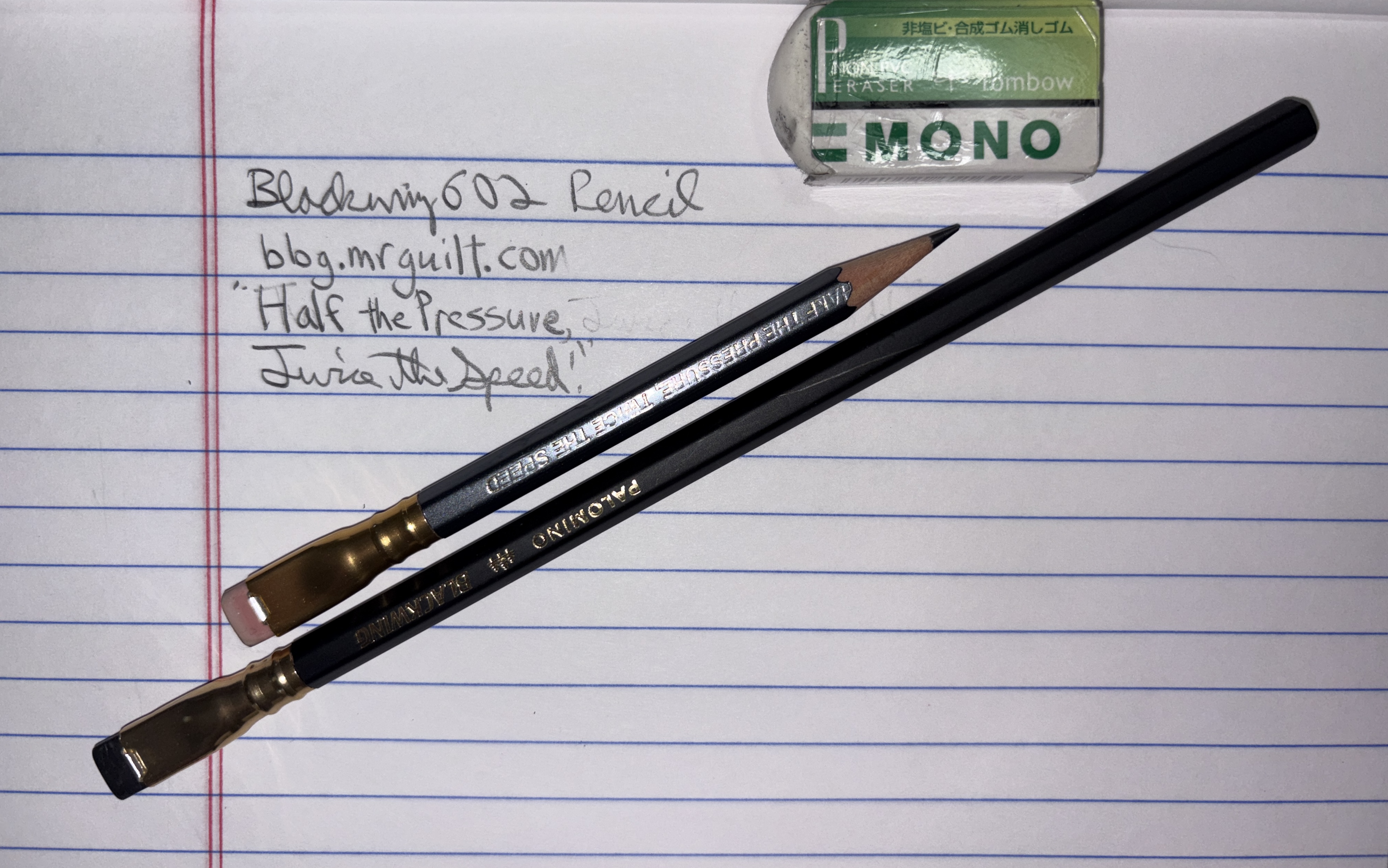
<figure>
	<a href="/images/blackwing-pencil/blackwings.jpg"><img src="/images/blackwing-pencil/blackwings.jpg" height="400px" /></a>
	<figcaption>A used and unused Blackwing 602 pencil</figcaption>
</figure>

<p>For me, for a while, it was <a href="https://blackwing602.com/collections/">Blackwing</a> pencils. A single woodcase pencil, at a typical-ish street price of $2, is nearly as much as a dozen in some stores. They had a cult following that, for a time, could command $40 <em>each</em> on eBay, and inspired a whole company to spin up to reproduce them. Even for a fountain pen collector, this seemed nuts. Could they really be <em>that</em> good.</p>

<p>I was primed to absolutely hate them.</p>

<h2 id="the-brief-history-of-the-blackwing-602">The Brief History of the Blackwing 602</h2>

<p>The <a href="https://en.wikipedia.org/wiki/Blackwing_602">Wikipedia Page</a> can give you a deeper dive. The <em>Wall Street Journal</em> made a nice <a href="https://www.youtube.com/watch?v=y8J_nYQge14">video</a> explaining the rebirth. These offer a lot more information that I won’t repeat. But I feel a <em>brief</em> overview is worth mentioning for the sake of context.</p>

<p>The original Blackwing was produced from 1934 to 1998, originally by the Eberhard Faber Pencil company, then by the various companies that it merged with or bought the brand. It was originally marketed towards stenographers, sold with the motto “Half the Pressure, Twice the Speed” stamped to each pencils. However, it’s smooth, dark lines made it a fan of Disney animators, playwrights, and novelists. As time went on, it became a bit of a niche product within the company’s line. In 1998, the machine that made the ferrule, the part that held the eraser, broke. It was deemed not cost effective to repair the machine for such a small market, so the Blackwing was quietly discontinued, letting the remaining stock run out.</p>

<p>Remaining stock became a prized item. As I said, individual pencils were selling on eBay for $40. A company bought the name, and set out to bring the pencil back to life. They spent time developing a lead that came as close to the original’s. As <a href="https://us.gestalten.com/blogs/journal/meet-caroline-weaver">Caroline Weaver</a>, pencil historian, put it, “I wouldn’t call it a reproduction. I’d call it a tribute.” Now, they produce thousands of pencils, and release several limited editions each year.</p>

<h2 id="so-just-what-is-a-blackwing-602">So Just What Is a Blackwing 602</h2>

<p>At its most basic, the Blackwing 602 is a woodcase pencil, meaning a piece of lead is encased in the middle of a wooden body. The wood is stripped away when it is sharpened, growing shorter until it is used up. This is opposed to a mechanical or drop-lead pencil, where a piece of lead inserted into a permanent body. Close your eyes, and imagine a “Number Two” pencil for the SATs: you’re imagining a round or hexagonal yellow body about six inches long, with a round eraser on top.</p>

<p>The most obvious difference in a Blackwing is the eraser: it is rectangular, and designed to be replaced over the life of the pencil. These days, I tend to use a block eraser, saving any built-in eraser for when I’m not at, say, my desk. The default 602 tends to be black, though its current manufacturer has come out with other designed—”limited editions.”</p>

<p>But what sets it apart is the lead. It produces a line that is the same as an HB (“#2”) pencil, but feels much softer. It simply feels nice and smooth to write with, and holds a tip rather well.</p>

<h2 id="what-do-i-really-think">What Do I Really Think?</h2>

<p>The office supply geek in me had to see what was driving this. The fact they had a long history and such a fan base intrigued me. Do they live up to the motto, “Half the Pressure, Twice the Speed?” Were they really <em>that</em> much better than any other woodcase pencil out there?</p>

<p>When I had the opportunity to buy a single piece, as opposed to a $32 dozen, I decided to try it, primed to hate it.</p>

<p>Instead, I found they delivered. It really is the best woodcase pencil I’ve ever used. I was a doubter until I tried one. But it really does require half the pressure, and feels as smooth as my nicest fountain pen. I really feel it represents a level difference from other woodcase pencils I’ve used. The wood and lacquer used in its production are clearly of high quality.</p>

<p>I don’t see myself as a regular consumer of Blackwings. I mostly write with fountain pens. When I need a pencil, I tend to reach for a mechanical pencil (most commonly a multipen with a pencil element). But I was glad to try them, and to be proven wrong. Sometimes, things get hype because they <em>really</em> are that good. After learning the history of the pencil, the office supply geek in me was very happy to see people trying to keep one of the legacy products alive for future generations.</p>]]></content><author><name>I. Charles Barilleaux</name></author><category term="Office" /><category term="Supplies," /><category term="writing," /><category term="review," /><category term="pencil" /><summary type="html"><![CDATA[There are some products that’s easy to hate on for their popularity. For instance, whatever the current trendy metal water bottle of the moment (Hydroflask, Stanley, etc.) seems to be an easy target for such ire.]]></summary></entry><entry><title type="html">BetterMouse Got Better</title><link href="https://blogtest.mrguilt.com/2025/09/28/BetterMouse-Got-Better.html" rel="alternate" type="text/html" title="BetterMouse Got Better" /><published>2025-09-28T07:45:00-04:00</published><updated>2025-09-28T07:45:00-04:00</updated><id>https://blogtest.mrguilt.com/2025/09/28/BetterMouse-Got-Better</id><content type="html" xml:base="https://blogtest.mrguilt.com/2025/09/28/BetterMouse-Got-Better.html"><![CDATA[<p>One of the tools I’ve become a fan of on my personal MacBook is <a href="https://better-mouse.com">BetterMouse</a>. It’s a utility that lets you configure your mouse. It gives fine control of speed and acceleration, and lets you define any auxiliary buttons you have on your mouse. It’s similar to Logitech’s <a href="https://www.logitech.com/en-us/software/logi-options-plus.html">Logi Options</a>, but with more options, as well as not tied to one vendor.</p>

<p>It’s noted in my <a href="https://www.mrguilt.com/uses-this.html">Uses This</a>, and got a mention in a <a href="https://blog.mrguilt.com/2025/09/04/My-Evolving-Uses-This.html">Recent Post</a>.</p>

<p>It has a few features that go beyond mice. For one, it allows keyboard bindings. I could map “sleep” or “volume up” to an alternate key, if the keyboard doesn’t have it natively. It’s not something I use (I tend not to use “media keys”), but I do like that, if I needed it, it’s in something I already have. I prefer not to have too many dedicated resident things.</p>

<p>I just updated to the latest version. I saw an interesting item in the release notes:</p>

<blockquote>
  <p>An onscreen notification for mic mute action.</p>
</blockquote>

<p>I hadn’t noticed this before, and started playing with it. Basically, if you assign it to a mouse button, it acts as a global toggle for muting the microphone. I can have whatever application that is using the microphone, like, say, Teams, not in focus while I’m doing something else, like editing a spreadsheet. If I need to talk, I can hit a button on the mouse I assign to it, and it will unmute. Hit it again, and it mutes. I tested it on a couple applications, and it works the way I expect.</p>

<p>I had this working <a href="https://blog.mrguilt.com/2021/04/27/Controlling-Mute-on-Zoom-with-my-Mouse.html">on my WorkTop</a> in the past, even getting a <a href="https://blog.mrguilt.com/2023/01/23/Global-Mute-and-POP-Mouse.html">mouse that had an extra button</a> as my take-to-the-office mouse. This was done through <a href="https://learn.microsoft.com/en-us/windows/powertoys/">PowerToys</a>, but has since become part of Windows 11, using the <code class="language-plaintext highlighter-rouge">Win+Alt+K</code> keystroke.</p>

<p>Unfortunately, this is <em>not</em> part of the standard MacOS, which would be nice. I had googled this before (and now). There are folks who have put together scripts and shortcuts, some requiring an additional third party tool. I’m glad that, if not native (or semi-native, like PowerToys), it’s something I already use.</p>

<p>So, I have another reason to recommend BetterMouse. This ties together in one place something I had to tie together in a more complicated fashion.</p>]]></content><author><name>I. Charles Barilleaux</name></author><category term="work,antiproductivity,technology,computers,software" /><summary type="html"><![CDATA[One of the tools I’ve become a fan of on my personal MacBook is BetterMouse. It’s a utility that lets you configure your mouse. It gives fine control of speed and acceleration, and lets you define any auxiliary buttons you have on your mouse. It’s similar to Logitech’s Logi Options, but with more options, as well as not tied to one vendor.]]></summary></entry><entry><title type="html">My Evolving “Uses This”</title><link href="https://blogtest.mrguilt.com/2025/09/04/My-Evolving-Uses-This.html" rel="alternate" type="text/html" title="My Evolving “Uses This”" /><published>2025-09-04T12:00:00-04:00</published><updated>2025-09-04T12:00:00-04:00</updated><id>https://blogtest.mrguilt.com/2025/09/04/My-Evolving-Uses-This</id><content type="html" xml:base="https://blogtest.mrguilt.com/2025/09/04/My-Evolving-Uses-This.html"><![CDATA[<p>While <a href="https://blog.mrguilt.com/2025/08/30/Welcome-Back-Again.html">rebuilding and moving</a> the sites I had on the Oracle Cloud server, I reviewed some of the pages I haven’t checked (or updated) in quite a while. I’ve done a bit of clean-up, noting things that were once “temporary” that have become more permanent.</p>

<p>One thing I did notice was my <a href="https://www.mrguilt.com/uses-this.html">Uses This</a> page on the <a href="https://www.mrguilt.com/">homepage</a>. Over the last, say, six months I’ve been making an explicit effort to get out of a rut in terms of the tools I use on the regular (as well as work in some new tools). The reasons range from feeling like a <em>de facto</em> standard isn’t cutting it anymore, recognizing how I work has changed, or change for its own sake. Clearly I’m going to update that, but what’s changing?</p>

<h2 id="text-and-document-editing">Text and Document Editing</h2>

<blockquote>
  <p>My main tool for writing and coding is combination of EMACS, Pandoc, and Markdown.</p>
</blockquote>

<p>On one hand, all of this is still part of my workflow:</p>

<ul>
  <li>EMACS is still what I use when I’m connecting to remote systems.</li>
  <li>Pandoc is still quite handy for changing formats. I especially like to use it for moving Markdown to HTML. I’ve taken to using it more with <a href="https://v5.chriskrycho.com/journal/read-the-manual/pbcopy-pbpaste/"><code class="language-plaintext highlighter-rouge">pbcopy</code>/<code class="language-plaintext highlighter-rouge">pbpaste</code></a>.</li>
  <li>Markdown is still leaned on quite heavily. I even found a <a href="https://gitlab.com/mdhr-extension/markdown-here-revival">Thunderbird extension</a> to compose emails in Markdown.</li>
</ul>

<p>The main thing that has changed is what I use on my MacBook for text editing. I’ve started using Microsoft’s <a href="https://code.visualstudio.com">Visual Studio Code</a> for coding, blog, and web page creation. I’m using it for the first draft of this very page. A large part of it was a desire to use something more contemporary–what the cool kids use. It uses TypeScript or JavaScript as extension languages. If I felt the need to write extensions, these are more useful to know than Elisp. It supports remote code editing (though, for this rebuild, I’ve been using EMACS local to the server in the interest of simplicity).</p>

<p>There is also an element of a desire to move away from EMACS. Its creator is not a man I wish to support, even if in usage numbers. At a minimum, he’s a bit of an extremist when it comes to the Free Software movement. He’s made some <a href="https://www.npr.org/2019/09/17/761718975/free-software-pioneer-quits-mit-over-his-comments-on-epstein-sex-trafficking-cas">bad comments about Epstein</a>, and plenty of cases where he’s created a hostile workplace at MIT.</p>

<p>The other factor is embracing my workflow. There was a joke that EMACS was an operating system disguised as a text editor. People would use it not only to write code, but do email, note taking, and a million other tasks. While a lot of people have extended it to work with contemporary workflows, I find it to be a bit cumbersome. I have to use other tools if I need to access something from a browser or phone, and there are tools that are simply better suited to the specific task. Rather than continue to shoehorn it into my workflow, I migrated to those tools.</p>

<p>One other, minor-but-related change is Microsoft released <a href="https://github.com/microsoft/edit?tab=readme-ov-file#build-instructions">an updated version of the old MS DOS 5 editor</a>. I’ve been installing this on my remote systems to get a lightweight editor for quick tweaks to things like configuration files. This is easier than learning <code class="language-plaintext highlighter-rouge">vi</code>.</p>

<h2 id="browsers">Browsers</h2>

<blockquote>
  <p>I use…Google Chrome because that seems to be the <em>de facto</em> standard right now.</p>
</blockquote>

<p>Google Chrome is still probably the <em>de facto</em> standard right now, but it’s starting to creak a bit. It’s performance has dipped, it hogs memory and power, and just doesn’t offer anything super-compelling. Folks are even recommending <a href="https://www.microsoft.com/en-us/edge/">Microsoft Edge</a>, a surprising shift from the days when Microsoft’s default browser’s only function seemed to be to download something better (granted, it was <a href="https://en.wikipedia.org/wiki/Internet_Explorer">Internet Explorer</a> at the time).</p>

<p>I also started using vertical tabs, with “windows” as the horizontal icons for different functions. It is a paradigm and workflow shift that I found has improved my workflow. I can keep tabs related to a given project together, and not have a big jumble. This was something I got from Edge at work. I started with <a href="https://arc.net">Arc</a>. Support was discontinued, as <a href="https://www.theverge.com/news/674603/arc-browser-development-stopped-dia-browser-company">they went to focus on an “AI-powered” browser</a>. No thanks.</p>

<p>Right now, I’m using <a href="https://kagi.com/orion/">Orion</a>. Frankly, I’m not in love with it, but it seems to be working. I’m still trying different browsers. But, as browsers didn’t change much after Chrome for a long while, it’s good to seem some more experimentation.</p>

<h2 id="office-suite">Office Suite</h2>

<blockquote>
  <p>To engage with the rest of the world, I use Microsoft Office. You have to have Word and PowerPoint to interact with the rest of the world. In my opinion, converting from alternatives never quite work, though in isolation there are a lot of perfectly fine options. That said, nothing does spreadsheets like Excel–I actively like it.</p>
</blockquote>

<p>For the most part, this hasn’t changed. I still need to send documents to others in Word format, and the world runs on Excel. If it was still the 1990s and paper was the primary output, I might be able to live in an alternative, but that’s not where we are.</p>

<p>That said, I’ve started to use <a href="https://support.apple.com/pages">Apple Pages</a> for some personal documents. It’s pretty nice. I could see using it instead of Word if I didn’t have to use Word everywhere else in my life.</p>

<h2 id="new-and-small-things">New (and Small) Things</h2>

<p>The biggest net-new thing in my workflow is <a href="https://www.notion.com">Notion</a>. It’s billed as a notetaking app. Previously, I used <a href="https://simplenote.com">Simplenote</a>, in part because it could sync with EMACS. But it was text-only. Some of the things I’m linking about it</p>

<ul>
  <li>Markdown support–both what I type, as well as import and export.</li>
  <li>Support for images</li>
  <li>Equal functionality across a native desktop client, a browser-based client, and phone client</li>
  <li>A database function that is more than just a static table. I can do some computation or reporting on it, or link databases in a relational database-y way.</li>
</ul>

<p>Notion has become a multi-purpose notebook. I will record things that I want for the long term, create templates, write drafts of blog posts, and similar things. I even keep “virtual pocket notebooks,” as a place to put small notes I normally would write in a pocket notebook (like one from <a href="https://fieldnotesbrand.com">Field Notes</a>), but don’t have one with me. It probably comes closest to “missing application” I original wrote about: a digital-native notebook with some enhanced spreadsheet/database capabilities.</p>

<p>There are two little menu bar utilities I’ve started to use. One is <a href="https://better-mouse.com">BetterMouse</a>. This allows better tuning of how my mouse works. It also allows me to configure other buttons on mice with auxiliary buttons. This is functionally similar to <a href="https://www.logitech.com/en-us/software/logi-options-plus.html">Logi Options+</a>, but support for other brands and a finer degree of control. It even supports configuration of the keyboard and trackpad.</p>

<p>The other menu bar utility is <a href="https://www.logitech.com/en-us/software/logi-options-plus.html">Maccy</a>, a clipboard manager. The main thing is that it keeps a history of what I copy, so I can retrieve it and paste in again later. It’s exact use case is hard to define, but when I’m editing web pages, coding, or even writing things, it’s super handy.</p>

<h2 id="the-frustration-of-multiple-systems">The Frustration of Multiple Systems</h2>

<p>I have changed jobs twice since that was originally written. One of my frustrations is I can find really cool tools for my personal use, but can’t leverage them at work. Part of it is that my WorkTop runs windows, so a lot of this stuff isn’t available. It’s also rather locked down, so I couldn’t install something I love at home (or an equivalent) if I wanted to. This is one of the reasons I use Microsoft Office rather than get serious about an alternative.</p>

<p>This is probably my biggest frustration with the <a href="https://www.theverge.com/2023/10/31/23938841/apple-macbook-pro-touch-bar-discontinued-proof-of-concept">Touch Bar</a>. In a world of GUIs, the function keys are not as dominant as they were back in DOS. Most laptops I know default them to media keys.<sup>1</sup> Putting a multifunctional control seemed like a great idea!</p>

<p>I tended to forget about it. The first, the Touch Bar was supported by every application. I could use <a href="https://folivora.ai">BetterTouchTool</a> to create my own mappings, though it was a bit of a pain. The bigger reason was bouncing to machines that lacked it. Office had great support. But, since Windows machines didn’t have a Touch Bar, my Office workflow never incorporated it.</p>

<p>This leaves me frustrated: I’d love to use Notion at work, or a clipboard manager. But I can’t! Granted, from the point of view of an employer, I get it. In a way, this defines my dream setup, more than anything: I’d like to have the ability to have complete control over <em>all</em> of my computing. If I want to use Notion, or <a href="https://www.apple.com/in/numbers/">Numbers</a>, or something else, I can simply live in it.</p>

<p>I realize that’s not likely, but it does define a general direction I’d like to go.</p>

<p>(Honestly, lately, my daydream would have me in some quasi-retired-from-IT state, running a stationary store/coffee shop that, while there would be WiFi and some technology, I’d run as much as I reasonably can analog-first.)</p>

<p><sup>1</sup>Where I can, I set those to be normal function keys. This works on my MacBook, but not the Dell WorkTop, which maps <code class="language-plaintext highlighter-rouge">home</code> and <code class="language-plaintext highlighter-rouge">end</code> to <code class="language-plaintext highlighter-rouge">F12</code> and <code class="language-plaintext highlighter-rouge">F12</code>, respectively.</p>]]></content><author><name>I. Charles Barilleaux</name></author><category term="work,antiproductivity,technology,computers" /><summary type="html"><![CDATA[While rebuilding and moving the sites I had on the Oracle Cloud server, I reviewed some of the pages I haven’t checked (or updated) in quite a while. I’ve done a bit of clean-up, noting things that were once “temporary” that have become more permanent.]]></summary></entry><entry><title type="html">Post Ride IFTTT Test</title><link href="https://blogtest.mrguilt.com/2025/08/30/Post-Ride-IFTTT-Test.html" rel="alternate" type="text/html" title="Post Ride IFTTT Test" /><published>2025-08-30T15:30:00-04:00</published><updated>2025-08-30T15:30:00-04:00</updated><id>https://blogtest.mrguilt.com/2025/08/30/Post-Ride-IFTTT-Test</id><content type="html" xml:base="https://blogtest.mrguilt.com/2025/08/30/Post-Ride-IFTTT-Test.html"><![CDATA[<p>My <a href="https://blog.mrguilt.com/2025/08/29/Welcome-Back.html">first post</a> of this reboot suggested I would likely be sporadic in my posts. Yet, here I am, the second in a single day! Actually, this is just a test using <a href="https://ifttt.com/">IFTTT</a> to use the blogs RSS feed to automatically post to <a href="https://www.threads.com/@mrguilt">my feed on Threads</a>.</p>

<p>(Yes, I said I am not entertaining delussions of being an influencer or this being nothing more than my random ramblings. But that doesn’t mean I want this to not <em>ever</em> be read. I have paper journals for my eyes only. A <em>little</em> publicity is not the worst thing in the world. One social network, just Threads, as oppoed to that <strong>and</strong> Facebook <strong>and</strong> Blue Sky <strong>and</strong> Mastodon <strong>and</strong> whatever else folks use.)</p>

<p>I’m also making a small to-do list for this blog, at a technical/functional level. In no particular order:</p>

<ul>
  <li>Make the tags useful. This may include a tag cloud, simple list of tags, or <em>something</em>.</li>
  <li>Some form of pagination for the main page. Have it show ten-or-so post per page.</li>
  <li>Maybe a calendar view. See all the post for a given month.</li>
  <li>Comments, because why not?</li>
</ul>

<p>Between the last post (when I had a crash program to move this to a new server) and this post, <a href="https://www.strava.com/activities/15642070994">I got in a bike ride</a>. I chased down and stayed ahead of a motorized skateboard, sustaining 22 MPH for a good while. We got to a point where I could turn off, and my heart rate was 165 BPM. I reminded myself I have a <a href="https://www.bikereg.com/lionhearts-cx">race tomorrow</a>, and probably need to leave something in the tank for that. Easy cruise home, then a shower.</p>]]></content><author><name>I. Charles Barilleaux</name></author><category term="meta," /><category term="cycling" /><summary type="html"><![CDATA[My first post of this reboot suggested I would likely be sporadic in my posts. Yet, here I am, the second in a single day! Actually, this is just a test using IFTTT to use the blogs RSS feed to automatically post to my feed on Threads.]]></summary></entry><entry><title type="html">Welcome Back (Again)</title><link href="https://blogtest.mrguilt.com/2025/08/30/Welcome-Back-Again.html" rel="alternate" type="text/html" title="Welcome Back (Again)" /><published>2025-08-30T10:30:00-04:00</published><updated>2025-08-30T10:30:00-04:00</updated><id>https://blogtest.mrguilt.com/2025/08/30/Welcome-Back-Again</id><content type="html" xml:base="https://blogtest.mrguilt.com/2025/08/30/Welcome-Back-Again.html"><![CDATA[<p>…trying this again.</p>

<p>So, this blog is self-hosted, with a static site generator called <a href="https://jekyllrb.com">Jekyll</a> (and good old fashioned <a href="https://httpd.apache.org">Apache</a> as the web server). Originally, I had this hosted on virtaul system on Oracle Cloud. Things were working well, until, after a series of upgrades, frustated commands, and a reboot, I killed the server.</p>

<p>I couldn’t get it back up.</p>

<p>In a fit of frustration, I destroyed the server and spun up a new one. That’s what cloud servers are for, right?</p>

<p>That didn’t work.</p>

<p>A primordial scream later, I decided to set everything back up on a cloud server I had doing nothing hosted by <a href="https://sdf.org">SDF</a>, my favorite retrocomputing site. My daughter invited me to go third-pace at <a href="https://birdiescoffeeco.com">Birdie’s Coffee Company</a>. After an hour and a half of typing in a variety of commands, google searches, opening firewall ports, and mild frustation, I have <em>most</em> of it up.</p>

<p>There were four core sites hosted on the original VM. My process for three of those sites was to draft it locally on my MacBook, and save it to some cloud storage that was also mounted on the VM. Then, I’d copy it over. Those sites were restored quickly.</p>

<p>I did not appear to do that for <a href="https://web.archive.org/web/20250215165512/https://identities.mrguilt.com/#expand">one site</a>. Unfortunately, it’s the site I tend to point most external folks to. I was able to go to the <a href="https://web.archive.org">Wayback Machine</a> to restore a copy from February. I’m going to have to clean up the links, but I think I’ll be able to restore it. It will just take a <em>lot</em> of search-and-replace. <em>UPDATE A FEW HOURS LATER: I’ve restored it at least to what the Wayback Machine had.</em></p>

<p>There are a few scripts and other minor configuration and creature comforts I’ll have to rebuild. That shouldn’t take terribly long.</p>

<p>What did I learn?</p>

<ul>
  <li>Take your time when upgrading.</li>
  <li>Take your time when troubleshooting a VM.</li>
  <li>My “draft local and save to the cloud” process has value.</li>
  <li>Back up your VMs.</li>
</ul>]]></content><author><name>I. Charles Barilleaux</name></author><category term="meta" /><summary type="html"><![CDATA[…trying this again.]]></summary></entry></feed>